
Dangote Supplies Most of Nigeria's Petrol. What Jobs Came With It
Dangote refinery runs above nameplate at 700,000 bpd and supplied around 71 percent of Nigeria's petrol in August 2026. Where the careers actually are.
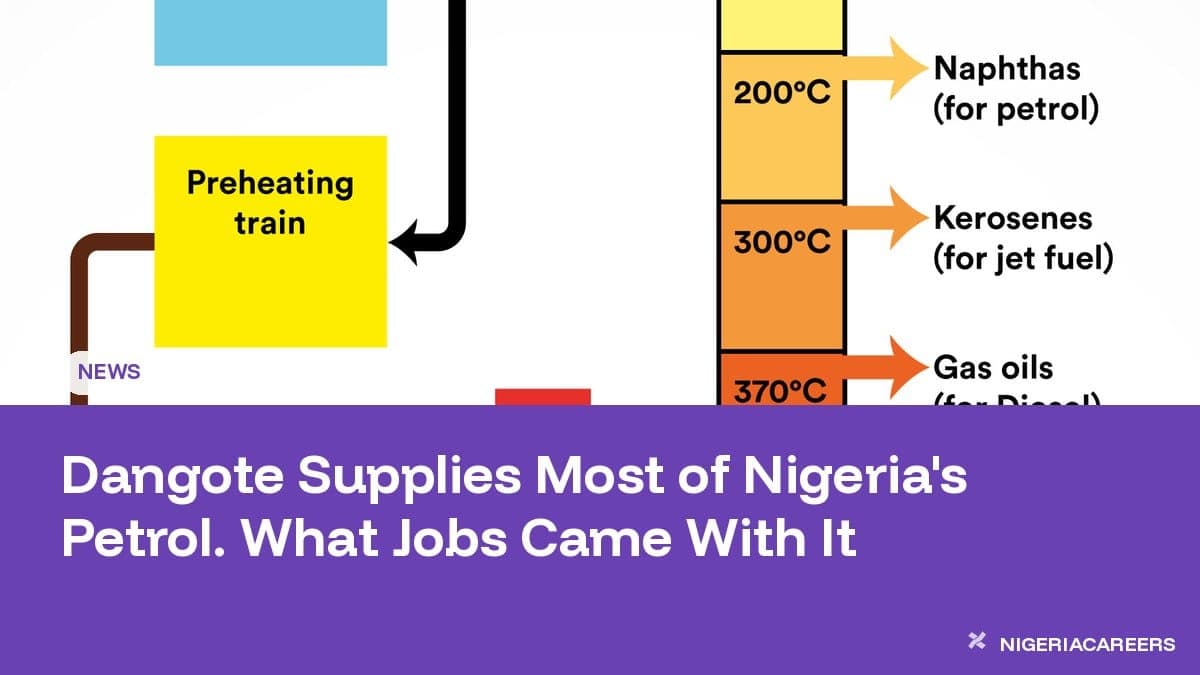
The Dangote refinery was built with a nameplate capacity of 650,000 barrels per day and reports from mid 2026 describe processing raised to 700,000, above its design figure. One analysis citing the midstream regulator's August factsheet put petrol production at about 41.94 million litres a day, while another report described average supply of 50 million litres a day to the domestic market in the first half of 2026. Those measure different things and should not be compared directly.
The headline number is the market share. One analysis attributed roughly 71 percent of Nigeria's petrol in August 2026 to the refinery. The expansion target is 1.4 million barrels per day, with cost estimates around 28 billion dollars and target dates reported variously as 2028 and 2029.
Refineries employ fewer people than their scale suggests
This is the part that disappoints, and it is worth being direct about. A modern refinery is highly automated. Permanent operational headcount at a facility of this size runs in the low thousands, not the tens of thousands, and a significant share of those roles are specialised process operators, instrument technicians, laboratory staff and maintenance engineers.
The large employment numbers associated with refineries are mostly construction and contractor work, which peaks during building and expansion and falls afterwards. The planned expansion toward 1.4 million barrels a day is therefore more significant as an employment event than current operations are.
Where the real job creation sits
Downstream of the refinery, not inside it. A country that has shifted from importing most of its petrol to producing most of it domestically has moved an entire logistics chain.
Truck fleets, depot operations, marine loading, storage terminals, quality control at distribution points, and the scheduling that moves product from Lekki to the rest of the country. These are operational roles in large numbers, and they are growing while refinery headcount is fixed.
Trading and supply is the higher value version. Someone decides where each cargo goes, at what price, against which hedge. Nigeria has historically had few people with real product trading experience because the function sat with international suppliers. That is changing and the skill is scarce.
Maintenance and turnaround is the third category. A refinery running above its design capacity requires disciplined maintenance, and turnarounds employ large numbers of contractors on a cycle. Rotating equipment, instrumentation, inspection and reliability engineering are durable specialisms with demand across the sector.
The export question matters for careers
Reporting notes that despite rising output the refinery has not broken into other African markets as expected. That matters for employment because an export oriented refinery needs trading, shipping, international compliance and marketing functions that a domestically focused one does not.
If export growth comes, those are roles based in Lagos serving African markets, which is a genuinely different career proposition from domestic distribution work. If it does not, the employment stays operational and local.
This is the single thing worth watching if you are planning a career around this facility.
What to do about it
For engineers, process operations and instrumentation at a refinery is a specialised and well paid career, and the entry route is almost always a trainee operator or technician programme rather than a direct hire. These programmes are advertised rarely and fill quickly, so watch the company's careers channel directly rather than job boards.
For non engineers, the accessible entry is logistics and supply chain. Depot operations, fleet management, scheduling and product quality control hire continuously and value people who can actually run an operation rather than people who studied it.
For anyone in finance, petroleum product trading and risk is the highest value specialism in the sector and the least represented in Nigeria. The qualifications are international and the experience is hard to get locally, which is exactly why it is worth pursuing.
Keep the figures in perspective
Most of the numbers here come from analyses and press reports rather than from the company or the regulator directly, and they vary. Production, supply and market share are measured differently across sources, and the expansion timeline is reported inconsistently.
The stable facts are that the facility is operating at or above nameplate, that it now supplies the majority of Nigeria's petrol, and that an expansion is planned. Those are enough to plan a career around. The precise litres per day are not, and anyone quoting them with confidence is quoting one source.
Filed under