
PAPSS Volumes Rose 1,000 Percent. The Careers Behind African Trade
PAPSS reports transaction volumes up about 1,000 percent and Nigeria up 1,100 percent. What the cross border payments build out means for finance careers.
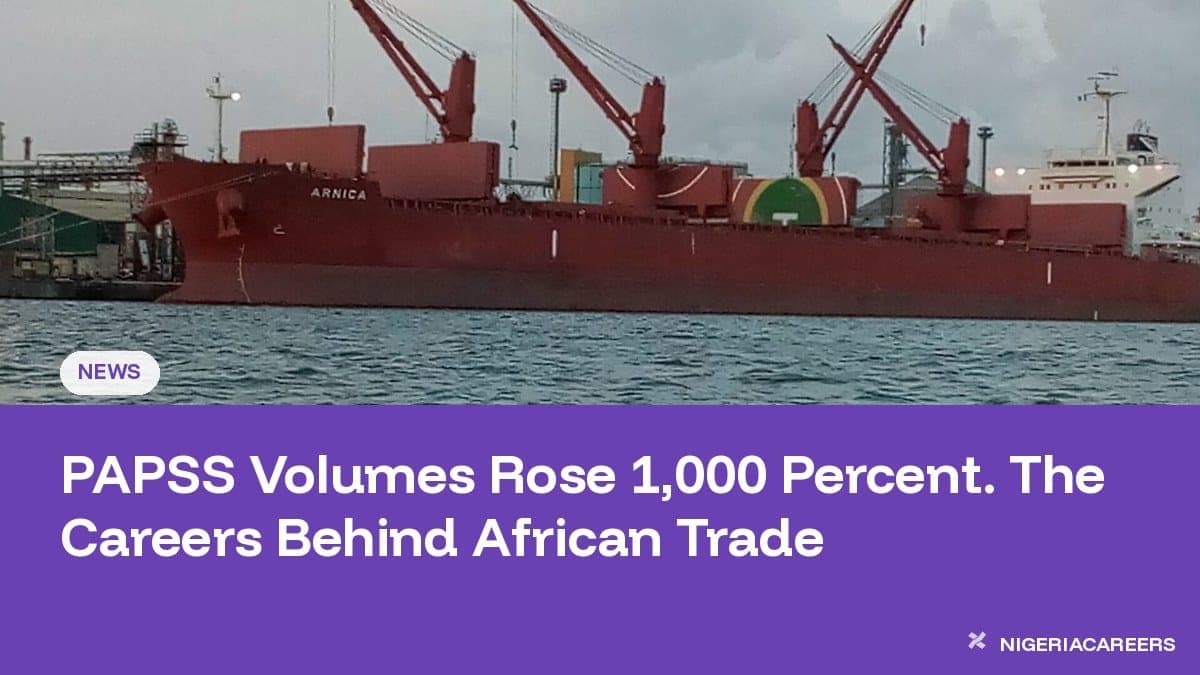
The Pan African Payment and Settlement System reported transaction volumes up roughly 1,000 percent and values up about 120 percent comparing similar periods in 2025 and 2026. Nigeria's growth was higher still, at approximately 1,100 percent by volume and 125 percent by value. The network now spans all five African regions with 24 national and regional central banks, more than 200 commercial banks and payment service providers, and 16 switches.
Those numbers come from PAPSS itself and should be read as directional. BusinessDay made a sharp observation about them: if both figures cover the same transaction population, average transaction value fell by roughly 80 percent, which means the growth is being driven by many small payments rather than by large trade settlements. That is a different achievement from the one the headline implies.
Why the distinction matters for your career
A rail carrying many small payments and a rail carrying large trade settlements need different people. The first is a consumer and small business payments business, built by engineers, operations staff and customer support. The second is trade finance, built by relationship bankers, documentary credit specialists, treasury staff and correspondent banking teams.
PAPSS was conceived for the second under the African Continental Free Trade Area, to let a Nigerian importer pay a Kenyan supplier in local currency without routing dollars through a correspondent bank in New York or London. If the actual traffic is small remittance style payments, then the trade finance transformation has not arrived yet and the jobs that follow it have not either.
What is genuinely growing
Cross border payments in Africa are expanding whoever wins. An older analysis put PAPSS at over 3.2 billion dollars in monthly transaction volume, up from 800 million in early 2024. Telco networks are building competing rails, with Airtel Money reported at 213 billion dollars in total payment volume in the twelve months to June 2026, which dwarfs the PAPSS figures.
Stablecoin corridors are a third contender, and Nigerian startups are active in that segment. Three technologies are competing to solve the same problem, and the skills that matter are mostly the same across all three.
The roles worth targeting
Treasury and foreign exchange operations. Someone has to manage positions in multiple African currencies, most of which are thin and some of which are not freely convertible. This is the hardest part of cross border payments in Africa and it is poorly staffed almost everywhere.
Correspondent banking and nostro reconciliation. Unglamorous, chronically short of experienced people, and directly relevant whether settlement runs through PAPSS, a telco or a stablecoin.
Cross border compliance. Anti money laundering across multiple jurisdictions with different rules, sanctions screening, and the beneficial ownership work that makes a corridor acceptable to a regulator. This is the function that most often blocks a corridor from launching.
Trade finance. If the AfCFTA volumes do arrive, letters of credit, documentary collections, supply chain finance and export credit become growth areas. Nigerian banks have shrinking trade finance teams after years of dollar scarcity, which means experienced people are scarce.
Payments engineering. ISO 20022 messaging, settlement finality, idempotent payment flows and reconciliation across systems that disagree. The messaging standard knowledge in particular is specific, learnable and in demand.
How to get in from where you are
If you work in a Nigerian bank's operations function, the move toward trade services or treasury operations is lateral and realistic. If you work in fintech operations, the gap is usually foreign exchange and compliance knowledge rather than technology.
If you are earlier in your career, the practical qualifications are the trade finance certifications offered by international banking bodies and a working understanding of how a payment actually settles between two countries. Very few Nigerian graduates can explain that, and it separates candidates immediately in an interview.
The realistic view
PAPSS says its focus shifts from 2027 toward market activation and adoption, which is an acknowledgement that building the rail was the easier part. Banks have to connect, treasuries have to be willing to hold African currencies, and traders have to trust it.
Plan on the basis that cross border payments in Africa is a real and growing field, and that which specific rail wins is unresolved. Build skills that survive the question rather than betting on the answer. Treasury, compliance and settlement knowledge are needed by every competitor in this market, which is exactly why they are the right things to learn.
Filed under