
How CBN's 2027 Payment Data Rule Reshapes Tech Careers
CBN Circular PSS/DIR/PUB/CIR/001/004 forces banks and fintechs to store payment data locally by Jan 1, 2027. See which tech and compliance jobs are booming.
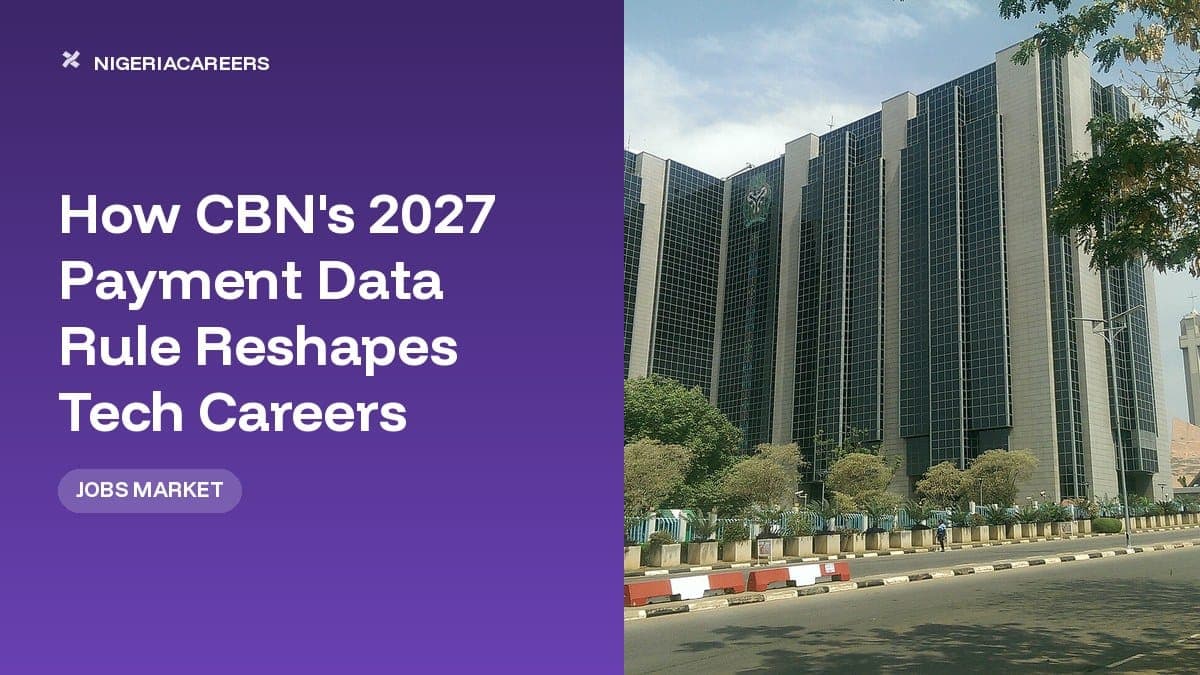
Every Nigerian bank, payment gateway, and mobile money operator must move its payment transaction data, backups, and disaster recovery systems onto servers physically located inside Nigeria by January 1, 2027.
That deadline comes from Central Bank of Nigeria (CBN) Circular PSS/DIR/PUB/CIR/001/004, signed by the Director of the Payments System Supervision Department, Rakiya Yusuf, on June 15, 2026. In November 2026, the CBN issued follow-up guidelines warning that there will be no automatic extensions.
For the past decade, Nigerian fintechs like Paystack, OPay, PalmPay, and Moniepoint built and scaled their products almost entirely on foreign cloud regions in Dublin, Frankfurt, or Northern Virginia. Those days are over for payment data.
Rebuilding the plumbing of an ecosystem that processed 11.2 billion transactions on the NIBSS Instant Payment platform in 2024 alone takes massive technical and legal manpower. If you work in DevOps, cloud engineering, database administration, cybersecurity, or legal compliance, this directive is the biggest hiring catalyst in Nigerian financial services right now.
What Circular PSS/DIR/PUB/CIR/001/004 Forces Employers to Do
The mandate covers every licensed player in the payments value chain. That includes Deposit Money Banks like Access Bank and Zenith Bank, microfinance banks, Payment Service Banks (PSBs), mobile money operators, switching companies, Payment Solution Service Providers (PSSPs), Payment Terminal Service Providers (PTSPs), and super agents.
The CBN rule is strict about what must stay inside Nigerian borders:
- Transaction records: Payment logs, timestamps, amounts, sender and receiver details, and settlement statuses.
- Customer financial identity (PII): Names, addresses, phone numbers, Bank Verification Numbers (BVN), and National Identification Numbers (NIN) linked to payment accounts.
- System and API logs: Webhook records, API call logs, and reconciliation data.
- KYC files: Identity verification documents, selfies, utility bills, and metadata.
- Backups and disaster recovery: The CBN's November 2026 clarification explicitly closed the offshore backup loophole. Secondary disaster recovery sites for regulated payment data must also sit within Nigeria.
General application code, marketing analytics, and internal HR systems can stay on foreign servers. Everything that touches a customer's money or identity must come home. Furthermore, under the CBN Customer Due Diligence Regulations, institutions must retain these records for at least five years.
The same circular also introduced strict market structure caps. Any payment operator holding more than 25% of the card issuing market must limit its merchant acquiring share to 15%, and vice versa. It also mandates full Ultimate Beneficial Ownership (UBO) disclosures. Together, these rules force financial institutions to restructure both their corporate entities and their server architectures at the exact same time.
Why the Cloud Migration Problem Creates a Talent Bidding War
Moving a live payment database handling millions of daily transactions without downtime is difficult. It is even harder in Nigeria because none of the big three global cloud providers (AWS, Microsoft Azure, or Google Cloud) operates a full, multi-availability-zone cloud region inside the country.
Wait-and-see is not an option for Chief Technology Officers. Even the AWS Africa region in Cape Town (af-south-1) sits outside Nigerian borders and does not satisfy strict domestic residency rules. Meanwhile, the AWS Local Zone in Lagos supports compute instances like Amazon EC2 and containers like EKS, but it does not natively support managed databases like Amazon RDS or standard Amazon S3 storage.
To keep their licences, banks and fintechs have to hire engineers who can build one of three complex alternatives:
- Hybrid Cloud with Sovereign Hardware: Shipping AWS Outposts racks or Azure Local hardware into a Nigerian colocation facility. AWS Outposts supports Amazon RDS (PostgreSQL, MySQL, and SQL Server) locally while connecting back to a parent region.
- Local Colocation and Private Cloud: Renting physical racks at domestic Tier III data centres and running self-managed Kubernetes clusters, bare-metal Linux servers, and self-hosted database clusters.
- Domestic Cloud Providers: Migrating workloads to local infrastructure providers such as UniCloud Africa or Kasi Cloud.
Most Nigerian software engineers trained over the last seven years only know how to spin up managed cloud services on a dashboard. Very few know how to manage physical network routing, configure hybrid Direct Connect links, or run high-availability PostgreSQL clusters on bare metal without data loss. That scarcity is driving salaries up.
Five Roles Hiring Fast and What They Pay
Companies are poaching directly from competitors and telecommunications firms to meet the January 2027 deadline.
1. Hybrid Cloud and DevOps Engineers
Fintechs need engineers who can split architectures so that stateless application fronts run smoothly while stateful payment databases reside on local servers. In August 2026, for example, Paystack actively recruited for a Senior DevOps Engineer in Lagos as industry migration timelines tightened.
- Junior DevOps / Cloud Engineer (0 to 2 years): ₦150,000 to ₦350,000 per month (2026 local benchmarks).
- Mid-Level DevOps Engineer (3 to 5 years): ₦350,000 to ₦700,000 per month.
- Senior / Lead Platform Engineer (6+ years): ₦700,000 to ₦2,500,000 per month at tier-one banks and funded fintechs in Lagos, where employers pay a 20% to 35% premium over other cities.
2. Database Administrators (DBAs) and Data Reliability Engineers
When you cannot rely on AWS RDS in Ireland to automatically handle your failovers, you need an in-house DBA. Banks and payment switches need specialists who can use tools like AWS Database Migration Service (DMS), configure active-active replication across two Nigerian data centres, and keep query latency low.
- What employers want: Production mastery of PostgreSQL, MySQL, Oracle, or Microsoft SQL Server, plus automated backup verification and point-in-time recovery.
3. Data Centre Facility and Network Engineers
The Nigerian data centre market reached a valuation of $374.05 million in 2026 and is projected to hit $782.82 million by 2031, growing at 15.92% annually. Major operators expanding local capacity include Rack Centre (which scaled its LGS 2 Lagos campus to 12 MW of IT power across 3,240 square metres), Equinix-owned MainOne (MDXi), Open Access Data Centres (OADC), Digital Realty Nigeria, and MTN's Dabengwa Data Centre.
- Who is hiring: Both the colocation facilities above and infrastructure integrators like Arravo and CommScope, who are building out fibre optics, intelligent cabling, UPS redundancy, and cooling systems for banking clients.
4. Data Protection Officers (DPOs) and Regulatory Compliance Leads
CBN Circular PSS/DIR/PUB/CIR/001/004 explicitly ties payment localisation to the Nigeria Data Protection Act (NDPA) 2023 and the General Application and Implementation Directive (GAID) 2025. Regulators are enforcing the rules with heavy fines: the Nigeria Data Protection Commission (NDPC) fined MultiChoice Nigeria ₦766.2 million in July 2025 and Fidelity Bank ₦555.8 million in August 2024.
Because the CBN stated in November 2026 that outsourcing to cloud vendors does not transfer regulatory liability, every payment participant needs a compliance boss to audit vendor contracts.
- In-house DPO / Information Security Officer: ₦500,000 to ₦600,000 per month at mid-sized Lagos corporates (October 2026 market listings), scaling past ₦1,000,000 per month at commercial banks.
- Regional / Group DPO: International fintechs operating in Nigeria, such as M-KOPA, advertised remote Group DPO roles covering Nigeria and East Africa at $56,420 to $104,780 per year in November 2026.
- Fractional DPOs: Advisory firms like PrivaLex Advisory and BIC Advisory are also hiring lawyers and privacy practitioners to provide retained, part-time DPO services to smaller PSSPs and microfinance banks.
5. Security and PCI-DSS Compliance Engineers
Moving data into local facilities opens new security gaps. Every payment processor handling card data locally must maintain Payment Card Industry Data Security Standard (PCI-DSS) certification, alongside ISO 27001 controls and hardware key management.
Exact Skills and Certifications to Add to Your CV Now
If you want to capture the salary bump from this regulatory shift, stop building generic portfolio apps and acquire skills that solve immediate migration bottlenecks.
For Software and Cloud Engineers:
- Learn Hybrid Infrastructure as Code (IaC): Master Terraform and Ansible for provisioning across mixed environments (connecting an AWS VPC or Azure environment to an on-premises server in Ikeja or Lekki).
- Master Self-Hosted Kubernetes and Linux Networking: Get comfortable running Kubernetes without managed cloud wrappers. Learn BGP routing, VPN tunnels, AWS Direct Connect, and firewall hardening.
- Target High-Leverage Certifications:
- AWS Certified Solutions Architect (Associate or Professional), specifically studying AWS Outposts and Local Zones architectures.
- Certified Kubernetes Administrator (CKA).
- Microsoft Certified: Azure Administrator Associate (with a focus on Azure Local / Azure Stack).
For Lawyers, Auditors, and Compliance Professionals:
- Master Contract Remediation: Read the CBN June 2026 circular alongside the NDPA 2023 and GAID 2025. Learn how to draft Data Processing Agreements (DPAs) and Service Level Agreements (SLAs) that legally bind local colocation providers to CBN uptime and residency audit standards.
- Learn Technical Data Mapping: A DPO who can read a system architecture diagram and spot an API webhook leaking customer BVN data to an offshore server is worth twice as much as a lawyer who only knows theory.
- Get Certified: Obtain a Certified Data Protection Officer (CDPO) credential recognised by the NDPC, or the international CIPP/E and CIPM certifications. Combine this with training on UBO disclosure frameworks and AML/CFT/CPF rules.
How to Position Yourself in Job Interviews
Whether you are an NYSC member interviewing for a junior tech role or a senior engineer negotiating with a bank, bring up Circular PSS/DIR/PUB/CIR/001/004 directly in your interview.
When asked if you have any questions for the hiring manager, ask: "How is your engineering team handling the database and backup residency split ahead of the CBN January 2027 localisation enforcement, and where do you need the most support?"
That single question proves you understand the business risk keeping the CTO and Chief Compliance Officer awake at night. Rewrite the top summary of your CV to highlight any experience you have with database migrations, latency optimisation, on-premises Linux administration, or NDPA compliance audits.
Frequently Asked Questions
Does the CBN data localisation rule stop Nigerian tech workers from getting remote jobs with foreign companies?
No. The mandate applies only to payment transaction data generated within Nigeria by CBN-licensed institutions and payment participants. You can still work remotely for foreign companies in the US, UK, or Europe, where remote Nigerian DevOps engineers earn between $3,000 and $8,000 per month. In fact, local banks now have to compete against those remote dollar rates to keep experienced infrastructure engineers in Nigeria.
Are non-fintech startups required to move their servers to Nigeria by January 2027?
If your company is an e-commerce store, edtech platform, or media business that simply uses a licensed gateway like Paystack or Flutterwave to collect payments, the CBN circular does not force you to host your website in Nigeria. However, if your startup facilitates payments directly, holds a switching, PSSP, or microfinance licence, or stores raw payment logs and customer BVNs on behalf of financial institutions, you must comply. Note that government data is separately required to be hosted locally under Section 13.1(2) of NITDA's Nigerian Content Guidelines.
Which companies in Nigeria are hiring the most for data localisation projects right now?
Hiring is concentrated across three groups. First, commercial banks (such as Access Bank and Zenith Bank) and high-volume payment platforms (such as OPay, PalmPay, Moniepoint, and Paystack). Second, domestic colocation and cloud infrastructure providers expanding capacity, including Rack Centre, Equinix MainOne (MDXi), Open Access Data Centres (OADC), Digital Realty Nigeria, and UniCloud Africa. Third, cloud migration consultancies and Big Four advisory firms like KPMG, PwC, Arthurite Integrated, and Arravo that banks hire to execute the migrations.